
Full-funnel marketing reflects how modern consumers actually discover and purchase products.
A shopper first notices a brand through an influencer they’ve been following for years. Later, they see the brand mentioned again in an AI-generated answer which links back to an article from Forbes or Wired. Finally, they find a promotional link from a partner site, right as they’re ready to purchase.
These interactions form the modern partner marketing funnel, and brands that coordinate each stage are far more likely to convert influence into revenue.
Why Brands Are Shifting Toward Full-Funnel Marketing
Partner marketing environments have changed quickly.
Customer acquisition costs continue to rise across paid media. Discovery increasingly happens through influencers, micro-communities, and AI-generated answers, rather than traditional search results. At the same time, industry leaders expect clearer connections between marketing investment and revenue.
Many brands are discovering that isolated channels struggle to deliver predictable growth. Paid ads may drive traffic, but awareness without conversion pathways wastes budget. Conversion sites may lead to sales, but without discovery channels, the pipeline slows.
Full-funnel marketing solves this structural problem. It connects the influence of awareness with the measurable outcomes of performance marketing.
When discovery, evaluation, and conversion strategies align, partner marketing becomes a coordinated growth system rather than a collection of disconnected campaigns.
How the Modern Marketing Funnel Works
The traditional marketing funnel still applies, but the channels shaping each stage have evolved.
Top of Funnel: Discovery and Brand Awareness
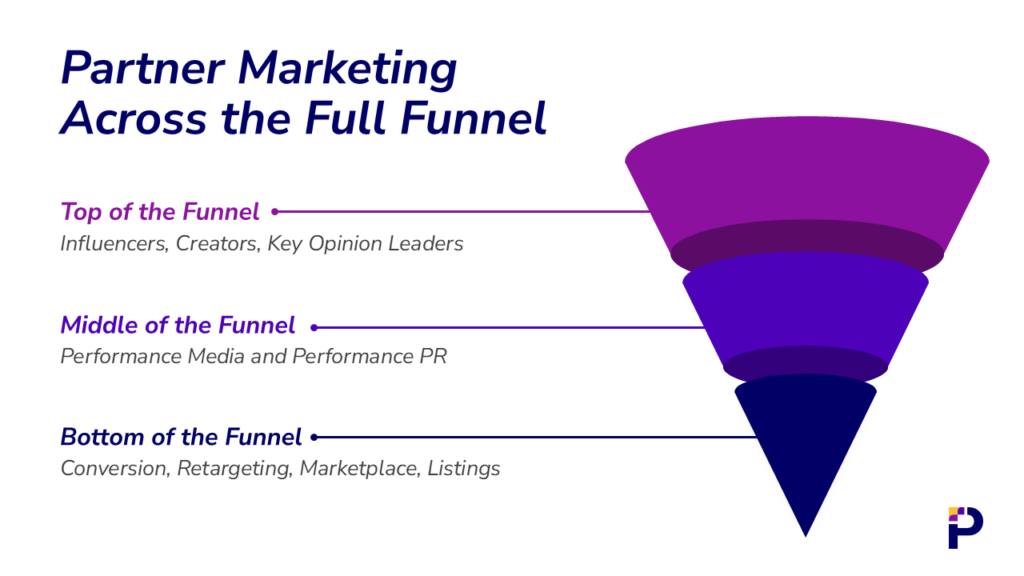
The first stage introduces potential customers to a brand.
Influencers and key opinion leaders play a major role in this stage. Creators demonstrate products and highlight emerging brands, while social platforms surface recommendations through algorithmic feeds.
This stage doesn’t always lead to an instant purchase. It’s meant to build familiarity and interest. In many industries, influencer marketing and creator-led discovery now drive what consumers decide to research next.
Mid Funnel: Consideration and Evaluation
Once awareness exists, consumers begin researching options, often aided by AI-driven searches.
At this level, advertisers who focus on share of voice and brand recognition are at an advantage. Performance media and public relations help brands show credibility and trust, as brands are cited in respected publications, with strong backlinking and AEO strategies.
Mid-funnel content lends credibility and authority to brands as consumers evaluate and consider the best options for their needs.
Bottom of Funnel: Conversion and Purchase
The final stage focuses on turning consumer intent into measurable revenue.
Performance-driven partners typically dominate the bottom of the funnel. These can include affiliate publishers, loyalty platforms, deal sites, retargeting, and listings; partnerships that are primed to help brands seal the deal.
For brands, this stage delivers the most measurable outcomes including revenue, customer acquisition, and return on ad spend.
How Partner Marketing Enables Full-Funnel Growth
Partner marketing naturally supports full-funnel strategies because various partner types influence different moments in the customer journey.
Influencers introduce products to new audiences. Media partners add credibility and authority. Affiliate marketing converts purchase intent into measurable sales.
Instead of relying on a single channel, brands can build ecosystems of partnerships that support each stage of the funnel.
This structure also diversifies marketing risk. Discovery does not rely solely on paid ads. Conversion doesn’t depend on a single brand partnership. Revenue growth becomes distributed across multiple channels.
How Brands Build a Full-Funnel Marketing Program
Successful full-funnel programs follow a structured approach.
First, brands identify partners that can drive discovery. This includes influencers and key opinion leaders. Next, mid-funnel content helps potential customers evaluate products through trusted voices and expert coverage. Finally, performance-oriented partners capture purchase intent through affiliate programs and promotional placements.
Coordination across these partnerships matters. Campaign timing, messaging, and incentives should align, so awareness leads naturally to conversion.
How Perhaps Helps Brands Execute Full-Funnel Partner Marketing
Executing a full-funnel strategy requires strategic alignment across multiple partner types.
Perhaps Agency helps brands structure partnerships that influence the entire customer journey, combining influencers, affiliates, and media into a unified growth strategy.
We aid with strategic account management, so every partnership is aligned and working toward your goals. Through AI-enabled analytics, we help brands demystify the data, so you get the results you need in real time.
The result is a partner marketing ecosystem where influence and performance work together rather than operate in separate channels.
The Future of Full-Funnel Marketing
The next phase of partner marketing makes full-funnel strategies even more relevant.
AI-powered search engines, social platforms, and creator ecosystems continue to reshape how customers discover products, and brands need to stay ahead of the game.
Brands that connect awareness, evaluation, and conversion into coordinated partnership ecosystems will be well positioned to build trust and drive sustained growth, despite the changes.